The Cironiiformes consist only of one family of birds - Ciconiidae, the Storks. Storks are large birds, 2-5 feet in height. They have long necks and long legs, both of which are useful for wading and fishing. They also have straight, sharp, long bills, which are thicker and stronger than the bills of other wading birds. Storks lack powerdowns, which many other wading birds have in place of a preen gland. They also lack a syrinx, and are thus mute. Vocal communication in storks is achieved by
bill clattering. They are heavy birds with great wingspans. The Marabou Stork has the largest wingspan of all birds (almost 11 feet), with the exception of the Andean Condor. The phylogeny of the Ciconiiformes is show below. (Hashman)

 |
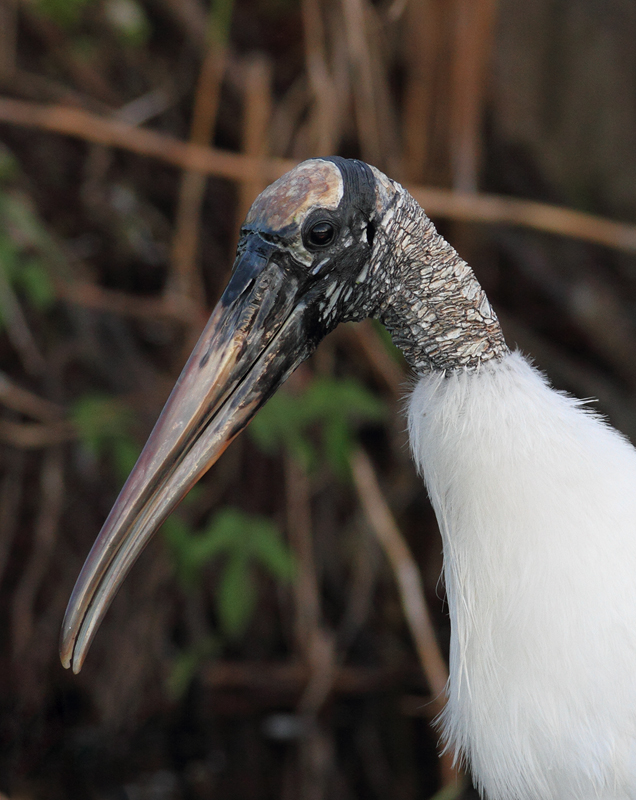
| The stout, sharp bill of the Wood Stork |
 |
| The long legs and bill of the Yellow-Billed Stork make for successful fishing excursions |
|
|
 |
| The enormous wingspan of the Marabou Stork |
The systematics of this order have a complex history. The 1994 edition of Gill has Herons, Ibises, Spoonbills, Egrets and other large wading birds with long necks and legs included in the Ciconiiformes. The Sibley-Ahlquist DNA study attempted to enlarge the order, but the diverse morphologies and DNA differences of the different families separated many of the above-mentioned species into Pelecaniformes. Flamingoes have also been lumped into the Ciconiidae from time to time, but are not currently classified there. New world vultures, Cathartidae, are also seemingly closely related to storks. However, at the present time, they are classified with the Accipitiridae. Thus, the order has retained only the Storks, Ciconiidae.
 |
| The Great Blue Heron is no longer classified in the Ciconiiformes |
 |
| Flamingoes are also not currently classified as Ciconiiformes |
|
 |
The Black Vulture, family Cathartidae, may be closely related to Storks and reclassified. Note the similar morphology of the head of the Black Vulture and the Wood Stork (above), both of which are dissimilar to the Heron and Flamingo.
|
Sources:
Sources:


Do you think the purpose of having a thicker bill is so that it can communicate better, or is it just for the ease of eating their prey?
ReplyDeleteI didn't know storks are mute. Thanks for the info.
ReplyDeleteReally nice job explaining the systemmatics!
ReplyDelete