Friday, June 29, 2012
The Wood Stork - endangered to threatened
The Wood Stork was recently down listed from endangered to threatened. The Wood Storks were put under the endangered species act in 1984, which has protected and allowed for their population to grow. From almost being extinct, the wood stork population has multiplied to 12,000 nesting pairs in the Southern states such as Florida, Georgia, and South Carolina. A wood stork recovery action plan was created in 2009 to speed up the down listing of the storks. Conservation efforts such as preservation and restoration of wetlands, protection of nesting areas, and management of water flow. With these efforts, the population of wood storks has continuted to grow. Hopefully, with a continuation of this great effort, eventually wood storks will be no longer be threatened and will be a complete success story.

Wednesday, June 27, 2012
Reproduction
Wood Stork
Wood Storks nest in large colonies and are low reproductive species; they only reproduce when abundant resources are available, this triggers the reproductive cycle to begin. They build nests in upper branches of trees in mangroves on islands in Florida and several nests can be found in the same tree. The nest is built by both male and female and is made out of sticks, vines, leaves and Spanish Moss; it is a cup shape.
Females lay 2-5 eggs and they are incubated by the pair for 28-32 days. The chicks are altricial and there is a fierce competition for food. By the time they are a week old, their parents are feeding them 15 times a day and grow rapidly. During the breeding season Wood Storks need about 400 pounds of fish to feed their offspring and themselves. Adults are known to fly 80 miles in search of food. When one is gone in search of food, the other is protecting the nest and the chicks. After 9 weeks they are fledging, but reach sexual maturity at 4 years old, giving them a long life history.
Wood Storks nest in large colonies and are low reproductive species; they only reproduce when abundant resources are available, this triggers the reproductive cycle to begin. They build nests in upper branches of trees in mangroves on islands in Florida and several nests can be found in the same tree. The nest is built by both male and female and is made out of sticks, vines, leaves and Spanish Moss; it is a cup shape.
Females lay 2-5 eggs and they are incubated by the pair for 28-32 days. The chicks are altricial and there is a fierce competition for food. By the time they are a week old, their parents are feeding them 15 times a day and grow rapidly. During the breeding season Wood Storks need about 400 pounds of fish to feed their offspring and themselves. Adults are known to fly 80 miles in search of food. When one is gone in search of food, the other is protecting the nest and the chicks. After 9 weeks they are fledging, but reach sexual maturity at 4 years old, giving them a long life history.
 |
| Wood Stork chicks. Note the difference in sizes. This is due to the competition for food. Often only one or two chicks will survive. |
Sources
Thursday, June 21, 2012
Vocalization
The Wood Stork's vocalization sounds like a bunch of babies crying. This vocalization can be easily distinguished from other birds because it can be related to a sound we often hear. It sound specifically like "wahh wahh wahh" on repeat. Although we have not been able to hear a wood stork on any of our trips, I would be interested in knowing if anyone has.
Here is link if you would like to listen: http://www.junglewalk.com/popup.asp?type=a&AnimalAudioID=7609
Here is link if you would like to listen: http://www.junglewalk.com/popup.asp?type=a&AnimalAudioID=7609
Tuesday, June 12, 2012
Ciconiiform Morphology
The Cironiiformes consist only of one family of birds - Ciconiidae, the Storks. Storks are large birds, 2-5 feet in height. They have long necks and long legs, both of which are useful for wading and fishing. They also have straight, sharp, long bills, which are thicker and stronger than the bills of other wading birds. Storks lack powerdowns, which many other wading birds have in place of a preen gland. They also lack a syrinx, and are thus mute. Vocal communication in storks is achieved by bill clattering. They are heavy birds with great wingspans. The Marabou Stork has the largest wingspan of all birds (almost 11 feet), with the exception of the Andean Condor. The phylogeny of the Ciconiiformes is show below. (Hashman)

The systematics of this order have a complex history. The 1994 edition of Gill has Herons, Ibises, Spoonbills, Egrets and other large wading birds with long necks and legs included in the Ciconiiformes. The Sibley-Ahlquist DNA study attempted to enlarge the order, but the diverse morphologies and DNA differences of the different families separated many of the above-mentioned species into Pelecaniformes. Flamingoes have also been lumped into the Ciconiidae from time to time, but are not currently classified there. New world vultures, Cathartidae, are also seemingly closely related to storks. However, at the present time, they are classified with the Accipitiridae. Thus, the order has retained only the Storks, Ciconiidae.
Sources:
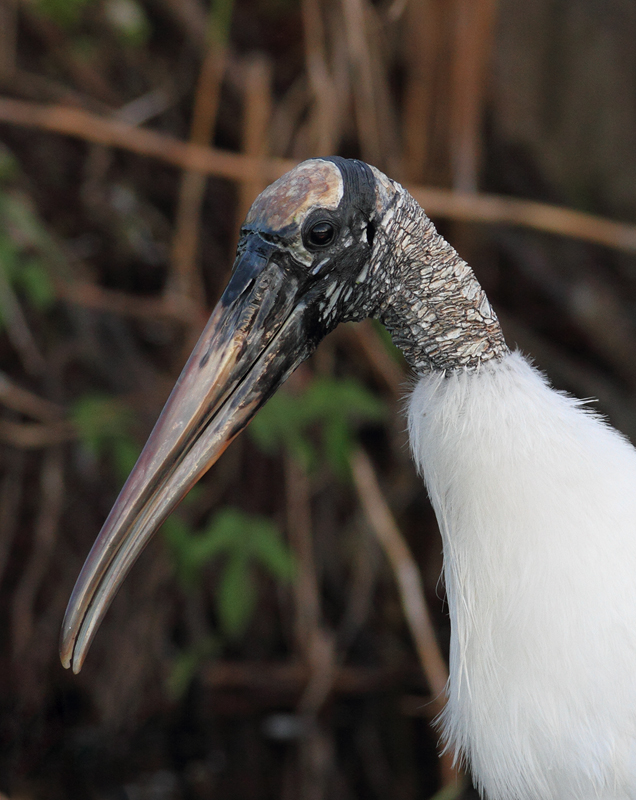 |
| The stout, sharp bill of the Wood Stork |
 | ||
| The long legs and bill of the Yellow-Billed Stork make for successful fishing excursions |
 |
| The enormous wingspan of the Marabou Stork |
The systematics of this order have a complex history. The 1994 edition of Gill has Herons, Ibises, Spoonbills, Egrets and other large wading birds with long necks and legs included in the Ciconiiformes. The Sibley-Ahlquist DNA study attempted to enlarge the order, but the diverse morphologies and DNA differences of the different families separated many of the above-mentioned species into Pelecaniformes. Flamingoes have also been lumped into the Ciconiidae from time to time, but are not currently classified there. New world vultures, Cathartidae, are also seemingly closely related to storks. However, at the present time, they are classified with the Accipitiridae. Thus, the order has retained only the Storks, Ciconiidae.
 |
| The Great Blue Heron is no longer classified in the Ciconiiformes |
 | |
| Flamingoes are also not currently classified as Ciconiiformes |
 |
| The Black Vulture, family Cathartidae, may be closely related to Storks and reclassified. Note the similar morphology of the head of the Black Vulture and the Wood Stork (above), both of which are dissimilar to the Heron and Flamingo. |
Sources:
- Encyclopedia Brittanica. Storks. http://www.britannica.com/EBchecked/topic/567579/stork. Retrieved June 12, 2012.
- Gill, F. 1994. Ornithology, pp 634-635. W.H. Freeman and Company, New York, NY.
- Harshman, J. Ciconiiform Phylogeny. http://tolweb.org/Ciconiiformes/26332. Retrieved June 12, 2012.
- Wikipedia. Ciconiiformes. http://en.wikipedia.org/wiki/Ciconiiform. Retrieved June 12, 2012.
Sunday, June 3, 2012
Ciconiiformes
This is a blog for the order Ciconiiformes which contains only one family: Ciconiidae, the birds in this order are storks.
Storks are long-legged and long-necked birds that wade in shallow water. They have long stout bills that are used to eat frogs, fish, insects, worms, small birds and mammals. Storks are heavy with a large wide wingspan. They tend to fly in a soaring fashion, which conserves energy.
Regional Distribution in Eastern NA
There is only 1 family: Ciconiidae, one genera and one species: the Wood Stork. They are mostly found in Florida and on the coasts Georgia and South Carolina.
Photos of Wood Storks


Storks are long-legged and long-necked birds that wade in shallow water. They have long stout bills that are used to eat frogs, fish, insects, worms, small birds and mammals. Storks are heavy with a large wide wingspan. They tend to fly in a soaring fashion, which conserves energy.
Regional Distribution in Eastern NA
There is only 1 family: Ciconiidae, one genera and one species: the Wood Stork. They are mostly found in Florida and on the coasts Georgia and South Carolina.
Photos of Wood Storks


Sources
Wikipedia
Sibley Field Guide
Sibley Field Guide
Subscribe to:
Posts (Atom)